The boredom test
The short answer: most tattoo regret isn't bad art. It's a design that got judged exactly once, on a screen, at the single moment of peak excitement — and then worn for forty years. A reference image gets a few seconds of your attention; a tattoo gets thousands of glances in bathroom light. Try-on's real job isn't telling you whether a design looks good. It's letting you get bored of it first. Put the mockup on your own body, sit with it for weeks, look at it on ordinary days, and see what survives.
Ask people who regret a tattoo what went wrong and most of them will say they picked a bad design. Push a bit and the story is usually different. The art was fine. Often the art was good. What failed was the decision — made in one sitting, at the top of an enthusiasm curve, based on a picture of someone else's arm.
Novelty is doing an enormous amount of work in that moment, and novelty has a half-life measured in weeks.
The asymmetry nobody accounts for
Look at what you actually judge a tattoo idea from. A saved image. Seen maybe a dozen times. On a screen, at a size you chose, from the one angle a photographer picked, freshly healed, on a body that isn't yours, with nothing else around it.
Now look at what you're committing to. The same design, seen by you every day for decades. At arm's length, in bad overhead light. In photographs you didn't pose for. Next to whatever else you already have. On your proportions, over your muscle, on a surface that curves away from you.
Those two experiences have almost nothing in common. Deciding the second from the first is the actual mistake, and it's upstream of every argument about style and placement.
What a try-on is actually for
Not "does this look cool." You already know it looks cool — that's why it's saved. The job is converting an imagination problem into an observation problem, and there are three things you genuinely cannot get any other way.
Scale. Nearly everyone's first instinct is too small. On a screen a design is whatever size the screen is; on a forearm it has to hold its own against the whole limb. Seeing it at true size on your own arm fixes this in about ten seconds, and it's the single most common change people make. Our guide to small tattoos that age well covers where the floor actually is.
Placement and neighbors. A piece that works in isolation can fight the thing next to it, or land somewhere that flexes and folds badly. This is a body-specific question, not a design question — more in how to choose placement.
Silhouette at distance. Look at the mockup from ten feet, not ten inches. If it turns to mush, the design is too busy for the size you've chosen. That's the same structural test that predicts how it will look in a decade, which is the argument in how tattoos actually age.
The test itself
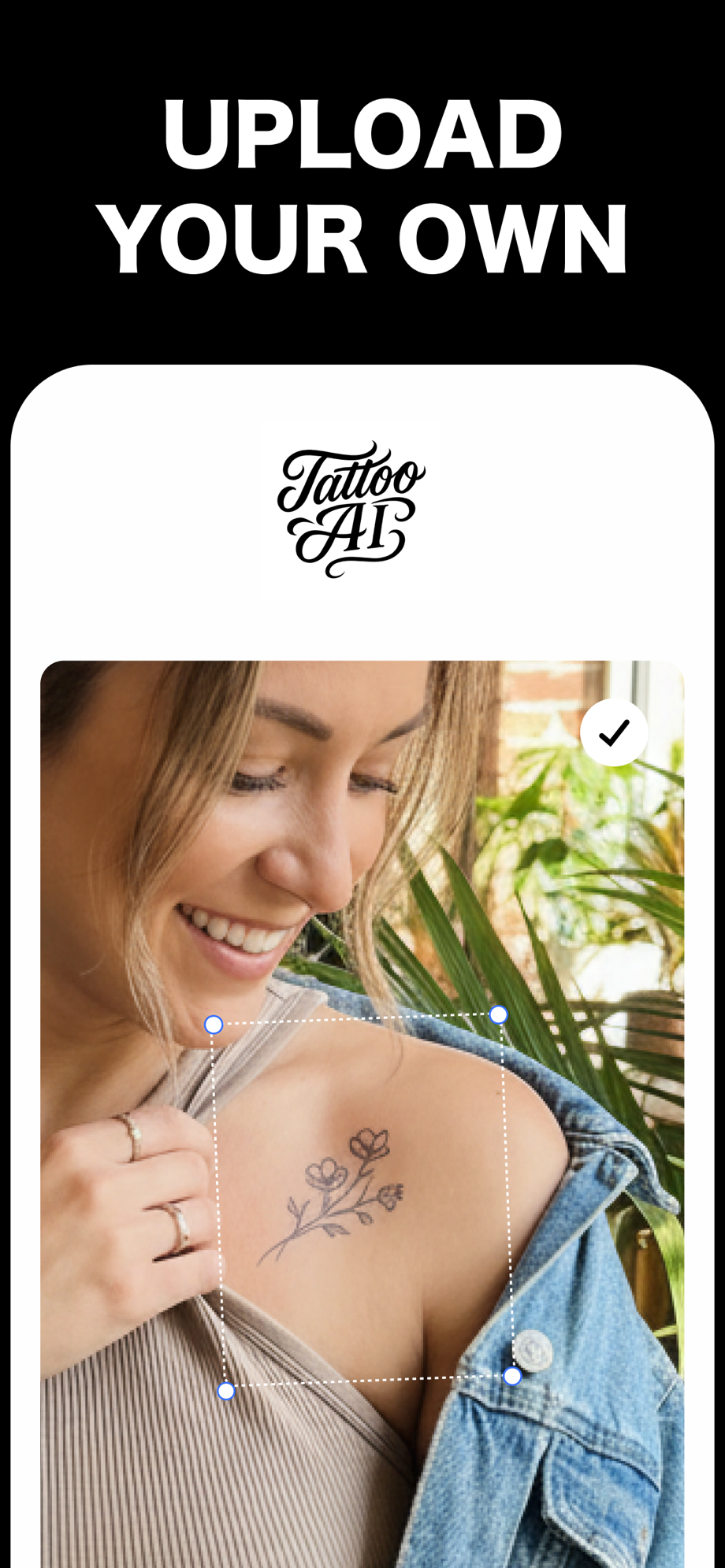
- Put it on your own photo, at real size. Not a stock arm. Yours, in the position you'll actually see it in most often.
- Then don't look at it for a week. The point is to break the loop where you keep re-triggering the excitement that got you here.
- Look again on an ordinary day. Not a day you're thinking about tattoos. If it lands as pleasantly unremarkable, that's a pass — a tattoo you'll live with should be able to be boring. If you wince slightly, that's your answer, and it cost you nothing.
- Check it in three unflattering contexts. In a bad mood. In something like a work photo. Directly beside whatever ink you already have.
- Make one variant a week. Same idea, different scale, placement, or line weight. Then watch which one you keep drifting back to. That drift is the most reliable signal available to you — far better than which one you liked hardest on day one. We wrote about how much a single idea can move in generating the same tattoo fifty times.
- Give it six weeks minimum. Mockups are free and reversible. The other thing isn't.
What survives boredom, and what doesn't
Structure survives. Bold shapes, a clear silhouette, real contrast — work that reads at a glance and doesn't demand anything from you. You can stop noticing it and it's still good, which is exactly what you want from something permanently attached to your arm.
What dies is anything that depends on being noticed. Cleverness fades fastest, topical references age worst, and very delicate detail loses the fight twice over — first to your attention, then to the ink spreading over the years, which is the honest picture in do fine line tattoos age well.
What a try-on genuinely can't tell you
Being straight about this, because the value of the test depends on knowing its edges:
- Nothing about healing. Ink spread, saturation on your skin tone, how a line settles after a year — a mockup has no opinion on any of it.
- Only half the geometry. A flat design on a photo still isn't a design wrapped around a limb, which is the whole problem described in flat art, round body.
- Not the final drawing. A good artist will redraw it to fit you, and should. What you're carrying in is a brief, not a file to be copied — the case for that is in AI isn't replacing your tattoo artist. And never hand over someone else's tattoo to be reproduced.
- None of the social half. How it sits with your job, your family, or how you feel wearing it in a room. Placement decides most of that — see the honest answer on hand tattoos.
The actual question
"Do I love this" is not a useful test, because the answer on day one is always yes. The useful question is quieter: on a Tuesday, when you'd forgotten the mockup was on your phone, do you still want it?
Everything you're going to regret fails that question in about three weeks — for free.
Free on the App Store · iPhone & iPad