AI isn't replacing your tattoo artist. It's writing them a better brief.
The short answer: bring an AI design to your artist as a reference, not a stencil. Say "this is the feeling, the composition, and the size I'm after — draw me your version." That's a brief, and artists like briefs. What they don't like is being handed an image and asked to trace it, partly because it disrespects the craft and partly because AI images frequently can't be tattooed as drawn.
There's a version of this conversation that goes badly. Someone generates an image, walks into a shop, and says "can you do this exactly." The artist looks at a design with lines that dissolve into nothing at three inches, shading that would turn to mud in five years, and a composition that doesn't wrap the limb it's meant for — and has to explain all of that to someone who's already emotionally attached.
There's another version that goes great. Same person, same image, different sentence: "here's the direction I'm chasing — this size, this placement, this energy. What would you do with it?" Now the AI image did its actual job, which is solving the hardest problem in getting tattooed: describing what you want.
The reference-photo problem
Every tattooer has the same story. A client says they want "something floral, kind of delicate, but not too girly," and the artist has to reverse-engineer a design out of four adjectives and a mood. Or the client brings in a screenshot of another artist's finished tattoo, which the artist can't and shouldn't copy.
Both failure modes come from the same gap: clients can recognize what they want instantly but can't produce it. An AI render closes that gap. It's not a design — it's a way of pointing at one.
What a good AI-assisted brief actually contains
- Two or three generated options, not twelve. Show the direction, not your entire exploration. Twelve images means you haven't decided anything yet.
- A photo of the placement with the design sized onto it. This answers the artist's first three questions — where, how big, which way does it flow — before they ask.
- One sentence on what you like about it. "I like how open it is" or "I want it bold like this." Tell them the property you're attached to so they know what's negotiable.
- One sentence on what you don't like. Just as useful. "The face is too detailed, I don't need it that photographic."
- Explicit permission to change it. Say the words. "This is a reference — I want your take." It changes the entire consult.
Why the placement photo matters more than the design
Of everything in that list, the sized-on-your-body photo is the piece artists find most useful, and it's the one almost nobody brings. Size and placement are where tattoos go wrong far more often than subject matter. A design nobody would question at seven inches on a forearm becomes unreadable at three inches on a wrist.
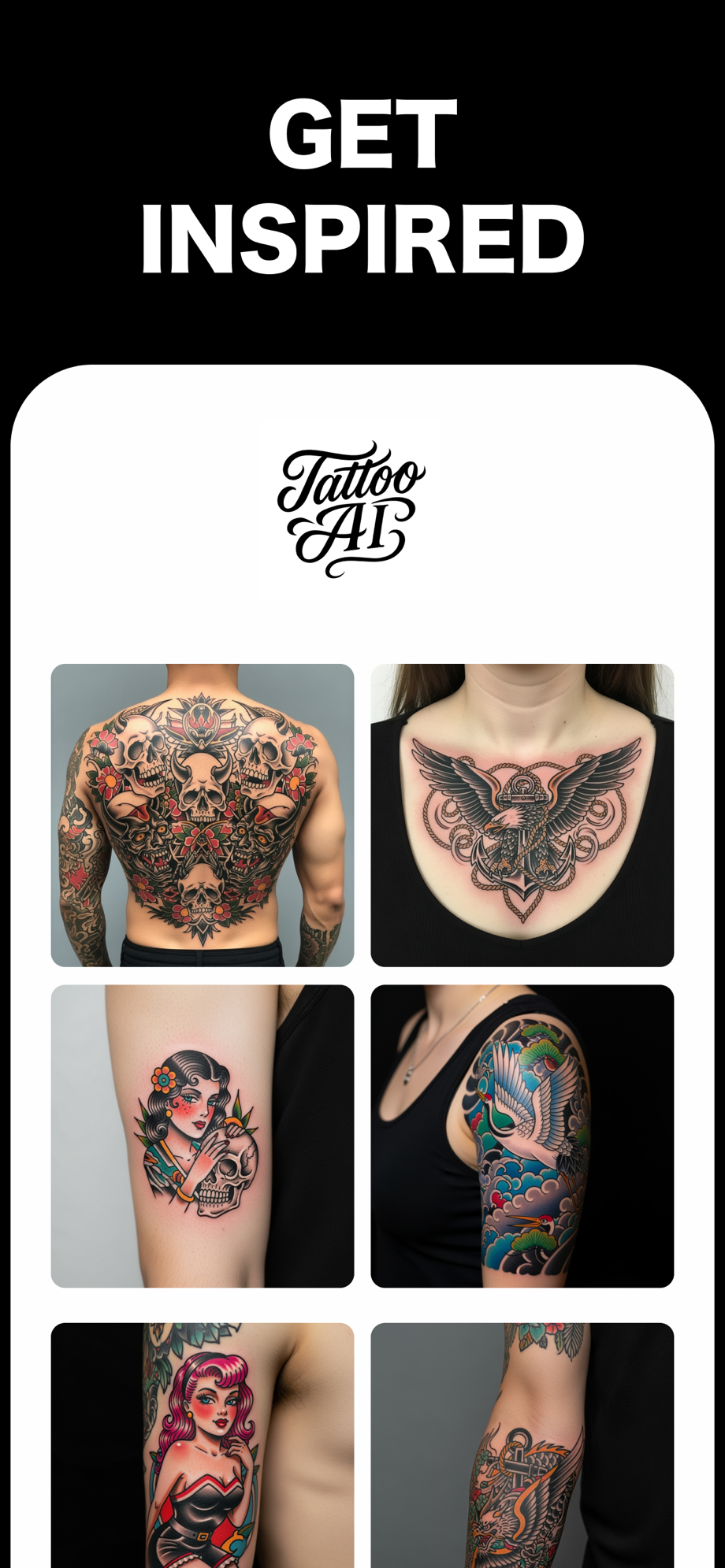
When you show up with the design already scaled onto your actual arm, the conversation starts at "let's refine this" instead of "let's figure out what you mean." That's an hour of consult you get back — and it's the reason we built try-on into the app rather than shipping a generator alone. Details in our try-on guide.
What AI genuinely can't do
Be clear-eyed about this, because the limits are the argument for your artist, not against them:
- It doesn't know how ink behaves in skin. A model renders an image. It has no concept of ink spread, of how a gradient blurs over fifteen years, or of which lines will close up. Your artist has that in their hands.
- It doesn't know your body. Muscle, curvature, how a design moves when you move. Japanese tattooing is built around this and no generator understands it.
- It doesn't do the linework. A tattoo is a physical object made by a person with a machine. The render is a picture of an idea.
- It doesn't know what's already on you. Fitting a new piece against existing work is a composition problem only a human standing in front of you can solve.
The etiquette, briefly
Lead with the fact that it's AI-generated — don't let them discover it. Never present another artist's work as a reference you want copied. Don't negotiate on the basis of "but the AI made it look easy." And when your artist redraws it into something better, which they usually will, let them.
The honest framing
Tattooing has always been collaborative, and the client's half of the collaboration has always been the weak link — not because clients don't know what they want, but because they have no way to show it. Flash sheets were an early fix. Pinterest boards were a worse one, because they trained everyone to point at finished tattoos instead of ideas.
A generated reference is the first tool that lets you point at your own idea. That's a better input into the same craft, not a substitute for it.
Free on the App Store · iPhone & iPad