How do tattoos age?
The short answer: every tattoo softens and spreads slightly over decades as ink particles migrate in the dermis and UV light breaks them down. How fast depends on five things, roughly in order: sun exposure, placement, line weight and spacing in the design, ink color, and skin care. Bold black work stays readable for decades; fine, dense, or colorful work softens noticeably in 5–10 years.
What physically happens to ink in skin
Tattoo ink sits in the dermis, held in place mostly by immune cells called macrophages that swallow the pigment particles and stay put. When one of those cells dies, a neighbor swallows the ink again — that relay is why tattoos are permanent. But the relay isn't perfectly stationary: particles drift a tiny amount with each handoff, so every line spreads microscopically, year after year.
Meanwhile, UV light breaks pigment particles into smaller fragments that your body can carry away. That's fading. Put the two together and you get the universal aging pattern: lines get slightly wider and softer, fills get slightly lighter, and tight details merge.
The five factors, ranked
- Sun exposure. The biggest factor you control. UV degrades ink faster than anything else in ordinary life — one unprotected beach summer beats years of normal wear. SPF 30+ on healed tattoos, forever.
- Placement friction and movement. Skin that flexes, rubs, or regenerates fast — hands, fingers, feet, inner wrist — blurs ink years sooner than calm zones like the upper arm or back.
- Line weight and spacing in the design. A 3mm Traditional outline can spread and still read perfectly. Two fine lines a millimeter apart eventually read as one. The design itself is an aging decision.
- Ink color. Black outlasts everything. Reds, oranges, and whites fade first; pastels and soft gradients go before saturated fields.
- Skin care and age. Moisturized, healthy skin holds detail longer. Collagen loss from your late 30s on softens everything a little — that part isn't optional.
What it looks like, year by year
| Age | Bold work (Traditional, Japanese) | Fine work (fine line, micro detail) |
|---|---|---|
| 1 year | Settled and healed; looks essentially new | Settled; thinnest lines slightly softer than day one |
| 5 years | Barely changed | Visible softening; tight details start to merge, sooner on hands and wrists |
| 10 years | Slight softening; still crisp and fully readable | Noticeably soft; small text and dense areas blur — touch-up territory |
| 20 years | Faded but clearly legible — bold black structure survives | Reads as a shadow of the design without touch-ups |
This is why American Traditional holds for decades while fine line work is realistically a 5–10 year piece before it wants attention, and why realism — which has no outlines to fall back on — expects softening around the 10-year mark.
What touch-ups can and can't fix
Touch-ups restore contrast: re-blacken faded fills, re-line soft edges, re-saturate color. They cannot un-spread a line. Once two tight lines have merged or tiny script has closed up, there's no needle that separates them again — only a cover-up or rework. That's the real argument for choosing a design that ages well up front rather than planning to fix it later.
How to choose a design that ages well
- Bold anchor lines. A solid outline is the skeleton that keeps a piece readable at year 20.
- Breathing room. Space between lines is a buffer against spread. Dense micro-detail is the first thing time deletes — this is why small tattoos need simple designs.
- A black base. Black shading under color keeps structure after the color softens.
- Calm placement. Upper arm, forearm, shoulder, back, thigh — not fingers or feet, unless you accept early touch-ups.
Run the aging test before you book
You can screen a design for aging problems in about a minute with Tattoo AI:
- Generate or upload your design — describe the idea in one of 16 styles, or upload artwork you already have.
- Upload a photo of the placement and place the design at true size on your skin.
- Look at the density. If lines already crowd each other on screen at real size, they will close up in skin. Screen-dense means skin-blurry.
- Simplify and re-check — fewer lines, more space, bolder anchors — until the piece reads clean at a glance.
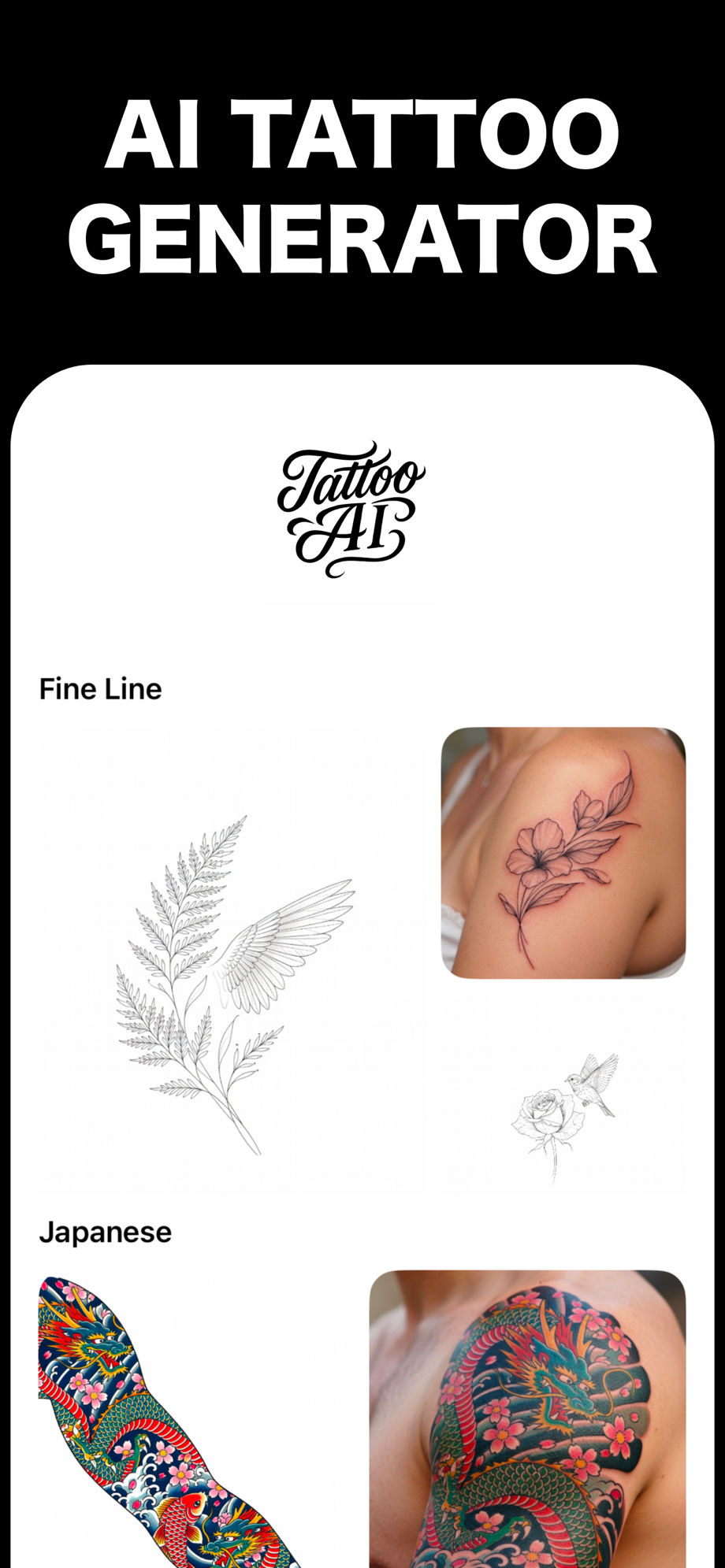
Free on the App Store · iPhone & iPad