Which small tattoo ideas actually age well?
The honest answer: small tattoos age well when the design is simple — a single symbol, bold clean linework, and open negative space between every line. They age badly when detail is packed into 1–2 inches: tiny script, portraits, and finely detailed animals blur as ink spreads in the skin over the years. Put small pieces on stable skin like the outer forearm, upper arm, or shoulder, and size up half an inch from whatever you were planning.
Why small tattoos blur
Every tattoo spreads. Ink particles migrate microscopically in the dermis for as long as you have the tattoo — it's not a defect, it's how skin works. On a large piece, a line drifting a fraction of a millimeter changes nothing. At 1–2 inches, that same drift closes the gaps between lines. Two strokes placed a millimeter apart eventually read as one thick stroke. A detailed design shrunk to keychain size doesn't stay a detailed design; it becomes a smudge with a silhouette.
The rule that follows: at small sizes, the space between lines matters more than the lines themselves. Designs that protect that space age fine. Designs that spend it don't.
What survives small — and what doesn't
| Ages well at 1–2" | Blurs at 1–2" |
|---|---|
| Single symbols: moon, lightning bolt, heart, cross, wave | Tiny script and dates under about half an inch tall |
| Bold, simple linework with even weight | Portraits of people or pets |
| Open negative space in the design | Detailed animals under 2 inches — wolf heads, lions, birds with feather detail |
| One-line (single-stroke) minimal designs | Micro-realism, tight geometric patterns, dense dotwork |
| Small Traditional motifs — built from bold outlines | Anything with fine shading gradients |
Script deserves its own warning because it's the most-requested small tattoo. Letters are made of tight parallel strokes — exactly what merges first. A name that's legible on day one at half-inch height can be guesswork in a decade. If the words matter, make them bigger or choose a cleaner font. Style choice compounds all of this: fine line work typically holds 5–10 years before wanting a touch-up, while bold Traditional linework holds for decades.
Smart placements for small pieces
Small tattoos have no ink to spare, so placement does double duty. Stable, low-friction skin — outer forearm, upper arm, shoulder, ankle, behind the ear for the tiniest pieces — keeps lines crisp longest. High-friction, high-movement spots like fingers, hands, and feet fade small tattoos fastest, sometimes needing touch-ups in 3–5 years. And since small pieces are often first pieces: the outer forearm, upper arm, and shoulder are also among the least painful spots to sit for.
The half-inch rule
Whatever size you're imagining, add half an inch. Nobody has ever regretted a small tattoo being slightly more legible; plenty of people regret a smudge. That extra half inch is the difference between line gaps that survive twenty years of spread and gaps that close in five. If sizing up "ruins" the design's delicacy, that's the design telling you it was too detailed for the size — simplify it instead.
Check legibility before you commit
The whole small-tattoo gamble — will it read at this size? — is testable in about two minutes with Tattoo AI, free on the App Store:
- Generate the small design — describe it and pick a style; Fine Line and Traditional both do small pieces well, with different aging trade-offs.
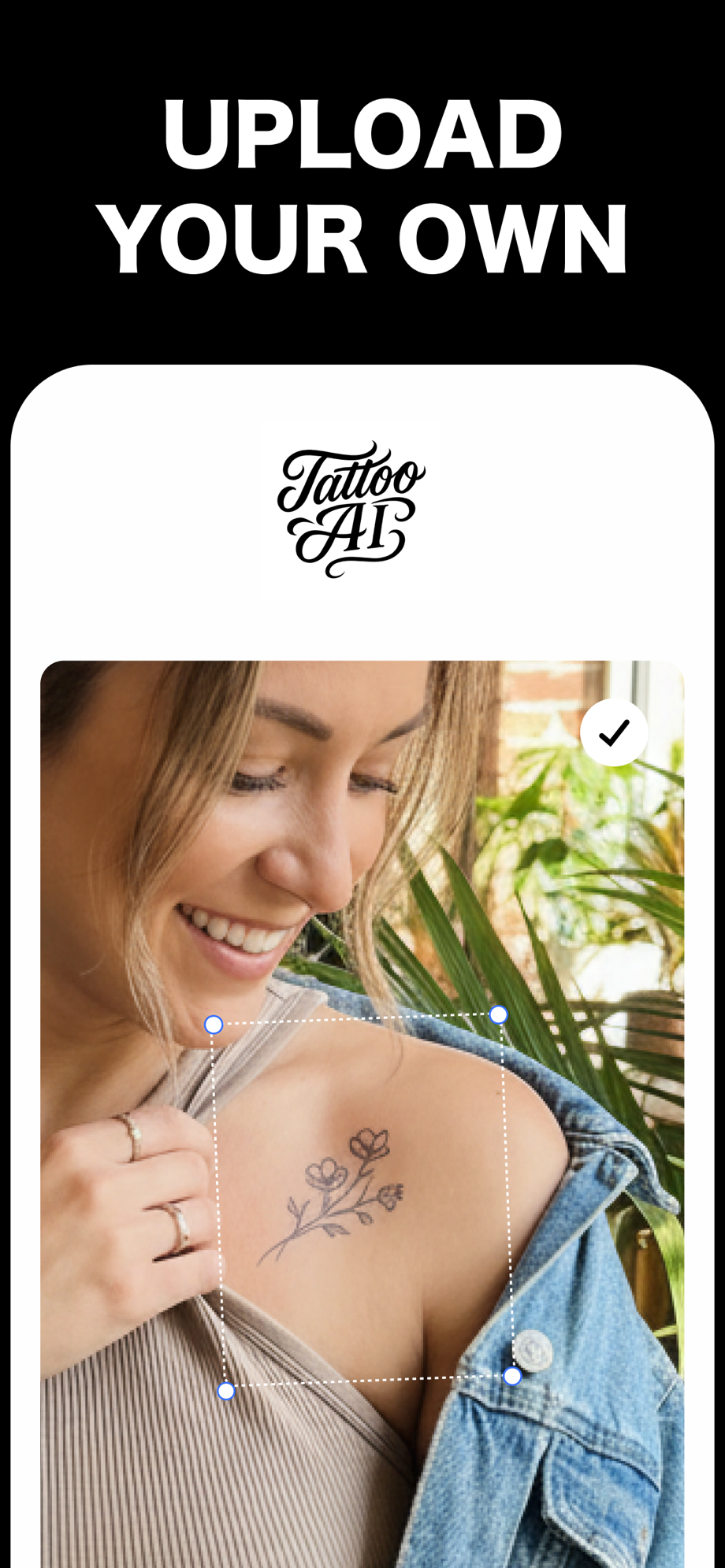
- Upload a photo of the spot — wrist, forearm, ankle, collarbone — and place the design at true size.
- Do the squint test — step back from the screen. If any detail already merges at real size on a photo, it will merge in your skin. Simplify or size up half an inch and re-check.
- Compare two placements — the same design on your forearm vs your wrist tells you where it stays legible.
Free on the App Store · iPhone & iPad