Tattoo styles explained: which one is right for you?
The short answer: most tattoos fall into a handful of major styles — American Traditional (bold lines, limited color), Neo Traditional (illustrative, richer palette), Fine Line (delicate single-needle work), Japanese (large-scale mythological pieces), Realism (photographic detail), and Script (lettering). The right one depends on your subject, your placement, and how you want it to look in 20 years — bold styles age best, delicate ones need touch-ups sooner.
Style matters more than most first-timers realize. The same rose reads completely differently as a bold Traditional flash piece, a soft fine line sketch, or a photorealistic black & grey portrait. And each version ages on a different clock. Here's what defines each major style, what it's best at, and where to go deeper.
American Traditional
The foundation of Western tattooing. Bold black outlines, a limited saturated palette — red, yellow, green, black — and heavy black shading. The imagery comes from flash sheets: eagles, panthers, roses, daggers, swallows, ships, pin-ups. It's not subtle, and that's the point.
Best for: classic iconography you want to still read clearly across a room in 30 years. Traditional's thick outlines tolerate decades of ink spread better than any other style — bold work holds for decades. Full breakdown in our American Traditional guide.
Neo Traditional
Traditional's structure with an expanded toolkit: varied line weights, a much wider palette, gradients, and illustrative depth pulled from art nouveau and vintage poster art. Animals, florals, and portraits rendered like storybook illustrations.
Best for: people who want the longevity of strong outlines but a subject Traditional can't render — a detailed fox portrait, an ornate floral piece. It ages nearly as well as Traditional. See neo traditional vs traditional for the full comparison.
Fine Line
Single-needle or small-grouping work: thin lines, minimal shading, delicate detail. Think botanical stems, tiny script, minimalist symbols, single-line drawings.
Best for: subtle, personal pieces — especially small placements like the collarbone, wrist, or behind the ear. The honest trade-off: fine line holds crisp detail for roughly 5–10 years, then softens, because there's simply less ink in the skin. Placement decides most of it. Details in do fine line tattoos age well.
Japanese (Irezumi)
Large-scale compositions built to flow with the body — full sleeves, back pieces, body suits. Mythological subjects: dragons, koi, tigers, hannya masks, peonies, waves and wind bars tying it all together. Strong outlines, dense backgrounds, deliberate negative space.
Best for: people planning big. Japanese is designed around the body's musculature, so it looks better in motion than any other style, and its bold structure ages well. It's a commitment — major pieces take many sessions. More in our Japanese tattoo guide.
Realism
Photographic rendering — portraits, animals, objects — in black & grey or color. No outlines; the image is built entirely from smooth gradients and contrast.
Best for: portraits and subjects where likeness is everything. Realism demands size (small realism turns to mush), an elite artist, and honest expectations: without outlines to anchor it, soft gradients blur first as the piece ages. Black & grey holds up better than color. Full guide: realism tattoos — what to know.
Script & Lettering
Words as the tattoo: names, dates, quotes, single words. Ranges from delicate cursive to blackletter to bold block type.
Best for: meaning-first pieces. The whole game is legibility over time — letter spacing, size, and font weight decide whether it still reads in 15 years. Thin cursive on a finger fails fast; well-spaced script on a forearm lasts. See script tattoo fonts for names.
Other styles worth knowing
- Blackwork. Solid black fields, bold graphic shapes, ornamental patterns. Ages extremely well — it's mostly solid ink.
- Geometric. Precise lines, sacred geometry, mandalas. Precision is the style, so pick an artist who specializes — a wobbly geometric piece has nowhere to hide.
- Watercolor. Soft color washes with little or no outline. Beautiful fresh; the most touch-up-hungry style on this list.
- Tribal. Bold black patterns rooted in Polynesian, Maori, and other Indigenous traditions. If the heritage isn't yours, work with an artist who understands the source culture.
- Dotwork / stippling. Shading built from individual dots. Distinctive texture, ages well when dots aren't packed too densely.
How the styles compare at a glance
| Style | Defining trait | How it ages |
|---|---|---|
| American Traditional | Bold outlines, limited palette | Best — holds for decades |
| Neo Traditional | Illustrative depth, rich color | Nearly as well as Traditional |
| Japanese | Large-scale, flows with the body | Very well at proper scale |
| Blackwork | Solid black graphic shapes | Very well |
| Realism | Photographic, no outlines | Good with size; gradients soften first |
| Fine Line | Single-needle, delicate | Crisp for 5–10 years, then softens |
| Watercolor | Soft washes, minimal outline | Fades fastest |
Can't decide? Try the same idea in three styles
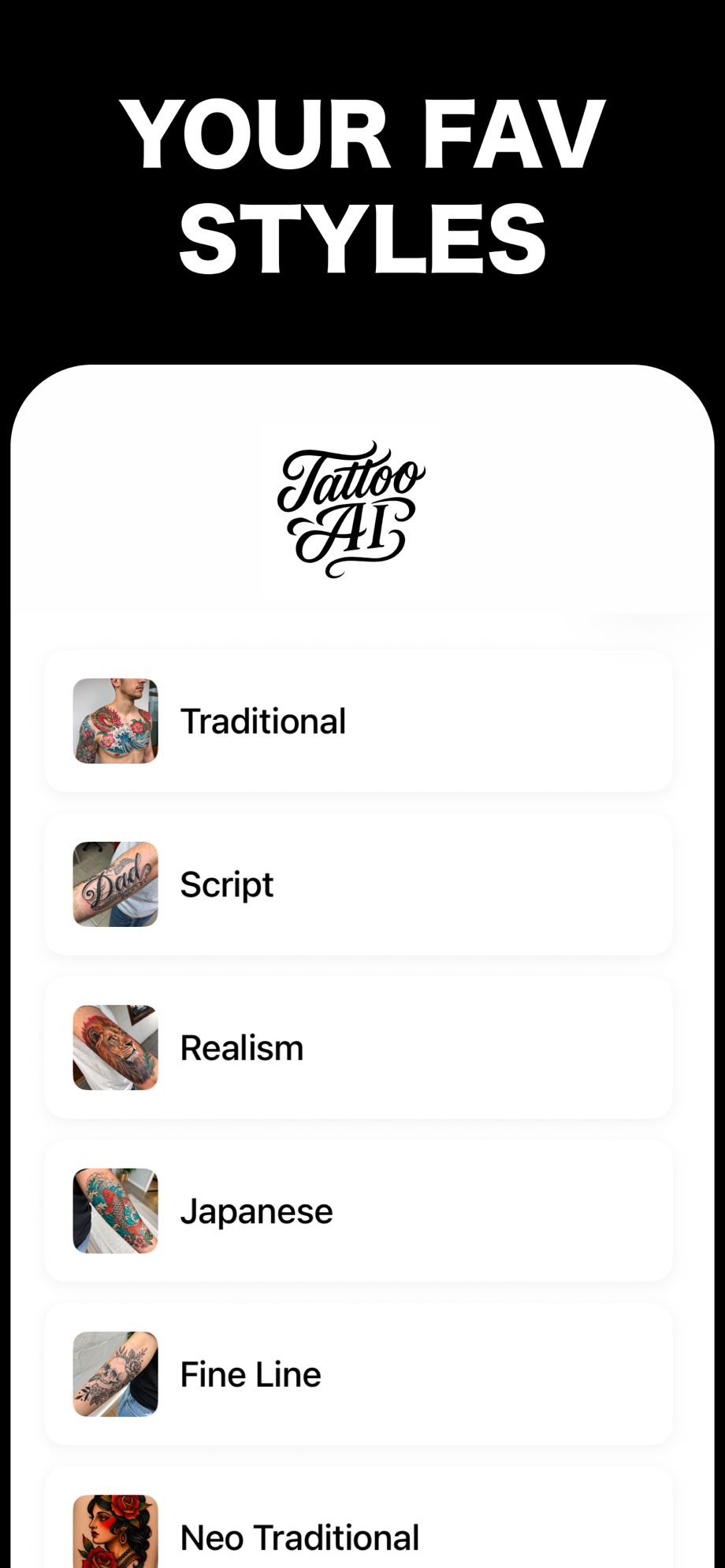
Reading about styles only gets you so far. The fastest way to choose is to see your idea rendered in each style, on your body. That's exactly what Tattoo AI does:
- Describe your idea once — "a wolf with pine trees," "a peony with my grandmother's name," whatever it is.
- Generate it in three styles — pick from 16 styles, including Traditional, Neo Traditional, Fine Line, Japanese, Realism, and Script. Run the same idea through the three you're torn between.
- Try each one on your skin — upload a photo of the placement you're considering, then place, resize, and rotate each version.
- Compare honestly — one version will click in a way the others don't. That's your style.
Free on the App Store · iPhone & iPad