Japanese tattoo meanings
The short answer: Japanese tattoo motifs carry set traditional meanings. The dragon stands for wisdom, protection, and strength; the koi for perseverance; the hannya mask for a jealous female demon from Noh theater that also serves as a protective symbol; the tiger for courage; the phoenix for rebirth; the peony for wealth; and the cherry blossom for the impermanence of life. Waves and wind bars tie it all together, representing life's constant motion.
The classic motifs and what they mean
Japanese tattooing (irezumi) has a fixed vocabulary refined over centuries. These are the motifs you'll see most, and what they traditionally signify.
| Motif | Traditional meaning |
|---|---|
| Dragon (ryū) | Wisdom, protection, strength. Japanese dragons are benevolent water spirits, not fire-breathing villains. |
| Koi | Perseverance — the fish swims upstream against the current. In legend, a koi that climbs the waterfall becomes a dragon. |
| Hannya mask | A jealous female demon from Noh theater. Often misread as pure evil — it's a portrait of grief and rage, and it's also worn as a protective symbol. |
| Tiger | Courage. Traditionally wards off evil spirits, bad luck, and illness. |
| Phoenix (hō-ō) | Rebirth and triumph — rising renewed from destruction. |
| Snake (hebi) | Protection against misfortune and illness; long tied to medicine and healing. |
| Peony (botan) | Wealth, good fortune, nobility — the "king of flowers." |
| Cherry blossom (sakura) | Mortality and impermanence. The blossoms fall at their most beautiful; so does everything. |
| Waves & wind bars | Life's constant motion. These background elements tie the whole composition together. |
Motifs also combine into set pairings. Koi with maple leaves reads as autumn. A dragon with a hannya mask stacks protection on top of raw emotion. A tiger in bamboo is a classic strength-in-adversity image.
Why Japanese pieces are built the way they are
Japanese tattooing is composition-first. The subject — dragon, koi, tiger — almost never floats alone. It sits in a field of waves, clouds, wind bars, and flowers that wrap the muscle and follow the body's lines. That background is not decoration; it's the connective tissue that makes a sleeve read as one piece instead of a sticker collection.
That's also why the style favors large canvases. A dragon needs room to coil. The traditional formats — full sleeve, half sleeve, chest panel, full back piece — exist because the imagery is designed to flow across an entire limb or the whole back. Scaled down to a 3-inch patch, most Japanese imagery loses exactly what makes it work.
Built at proper scale with bold outlines and dense black shading, Japanese work is also one of the best-aging styles in tattooing. Those heavy lines hold for decades.
One note worth carrying into the shop: these motifs have specific, well-documented meanings, so know what you're wearing before it's permanent.
Preview a Japanese piece at full scale before you commit
Scale is the whole question with this style. A back piece is a different decision than a forearm tattoo, and you can't judge it from a flash sheet. Tattoo AI lets you see it on your own body first:
- Generate the design — describe your motif ("dragon with peonies and waves") and pick the Japanese style. The AI drafts it with proper irezumi composition, background elements included.
- Upload a photo of your back, arm, or chest — the actual canvas you're considering.
- Place it at real scale — resize and rotate until the piece follows your body's lines the way a Japanese composition should.
- Compare formats — try the same motif as a half sleeve versus a back piece before you book anything.
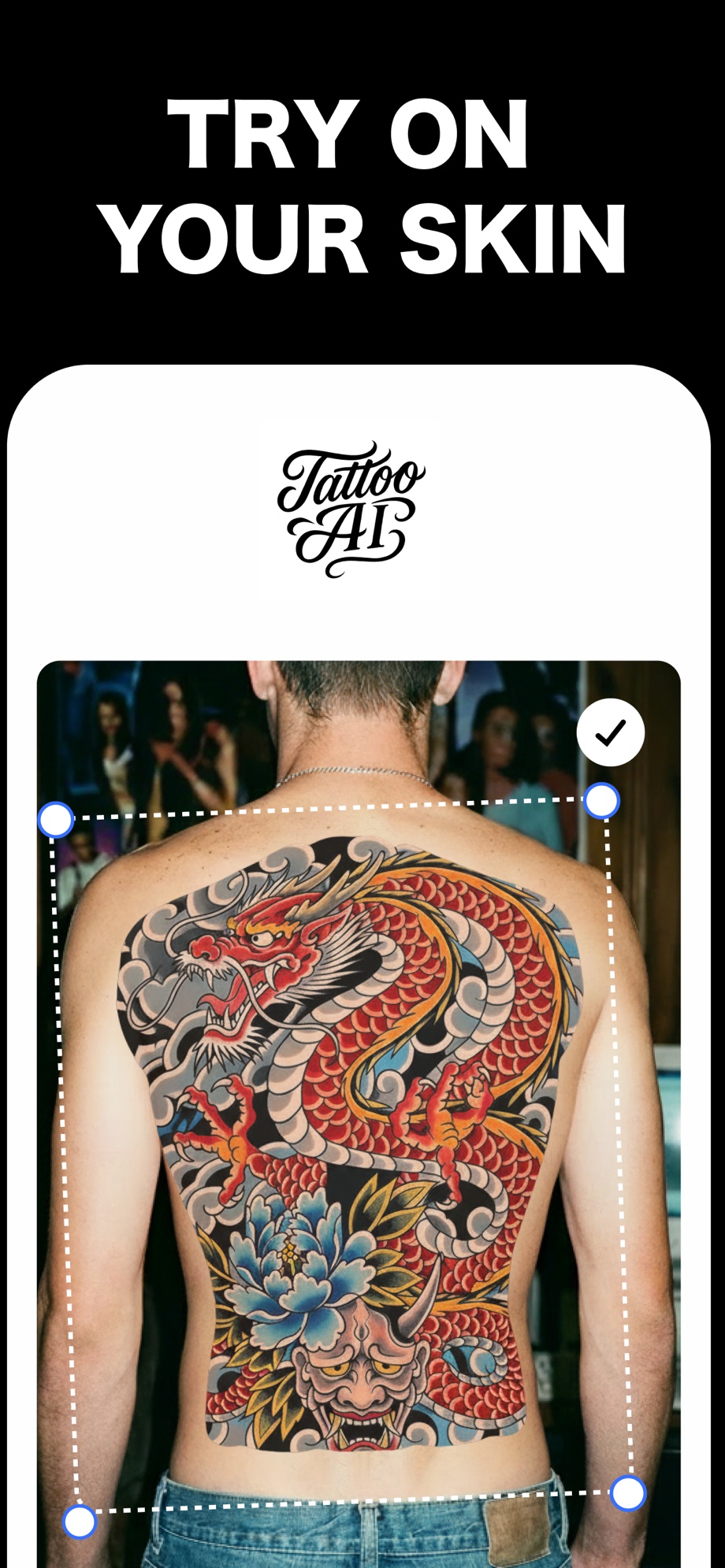
That screenshot is exactly this style in the app: a full-back Japanese dragon with a hannya mask and peony, placed on a real photo with adjustable handles.
Free on the App Store · iPhone & iPad