How do you plan a tattoo sleeve?
The short answer: decide which sleeve you're building before piece #1 — a planned sleeve (one artist, one theme, designed as a whole) or a patchwork sleeve (individual pieces collected over years, gaps filled later). Both are legitimate; mixing them by accident is how sleeves go wrong. Then pick the style, place big anchor pieces at shoulder and forearm, and expect 15–40+ hours across 5–10+ sessions over 6–18 months for a full sleeve.
The two roads — pick one first
Every regret-sleeve starts the same way: someone gets three unrelated pieces, then asks an artist to "make it a sleeve." Decide up front which road you're on.
| Planned sleeve | Patchwork sleeve | |
|---|---|---|
| How it's made | One artist designs the whole arm as a single composition | Individual pieces collected over years, gaps filled later |
| Flow | Best — elements wrap and connect by design | Deliberately collaged; charm is in the collection |
| Flexibility | Low — you commit to a theme and an artist | High — different artists, styles, eras of your life |
| Risk | Picking the wrong theme at 25 | Accidentally wanting "flow" at piece #6, when it's too late |
Neither is wrong. What's wrong is not choosing.
Pick the style before the imagery
Style consistency matters more than subject consistency. A Japanese dragon and a Japanese koi cohere; a realism dragon next to a traditional koi fights itself.
- Japanese and American Traditional were built for sleeves. Both styles come with a native connective vocabulary — water, wind, clouds, filler stars — invented precisely to tie an arm together.
- Realism sleeves need the most sessions. Smooth gradients over that much skin means slow work and more sittings — budget the high end of every estimate.
- Fine line and script can sleeve, but they read as patchwork by default; they lack heavy connective tissue.
Flow with the arm
An arm is a cylinder that bends and twists — sleeves that work are engineered for that.
- Anchor pieces first. The biggest elements go on the biggest flat zones: shoulder/upper arm and outer forearm. Everything else supports them.
- Connective background. Waves, wind bars, smoke, or filler stars fill the space between anchors and make one piece out of many. This is the difference between a sleeve and stickers on an arm.
- Wrap direction. Decide where the design's "front" faces — out toward the world, or in toward you. Elements should spiral around the arm in one consistent direction, not collide at the seam.
The numbers, honestly
- Full sleeve: 15–40+ hours across 5–10+ sessions, spread over 6–18 months. Dense realism or full-color Japanese lands at the top of that range.
- Half sleeve: roughly half of everything above.
- Cost: scales directly with your artist's hourly or day rate — the hours are the honest number, the price is just rate × hours.
- Spacing: 2–4+ weeks between sessions so skin fully heals before the adjacent zone gets worked.
A sleeve isn't a purchase, it's a project. Upper arm skin also holds ink beautifully for decades, so the investment ages well.
Where to start
The usual answer: shoulder down. The upper arm hurts less than the inner arm or elbow, heals easily, and the first anchor piece up top sets the scale for everything below. The other valid answer: whichever anchor piece you're most certain about — certainty first, geography second. Elbow, inner bicep, and armpit-adjacent skin hurt the most; most artists sequence those for the middle sessions when you're committed.
Prove the theme before session one
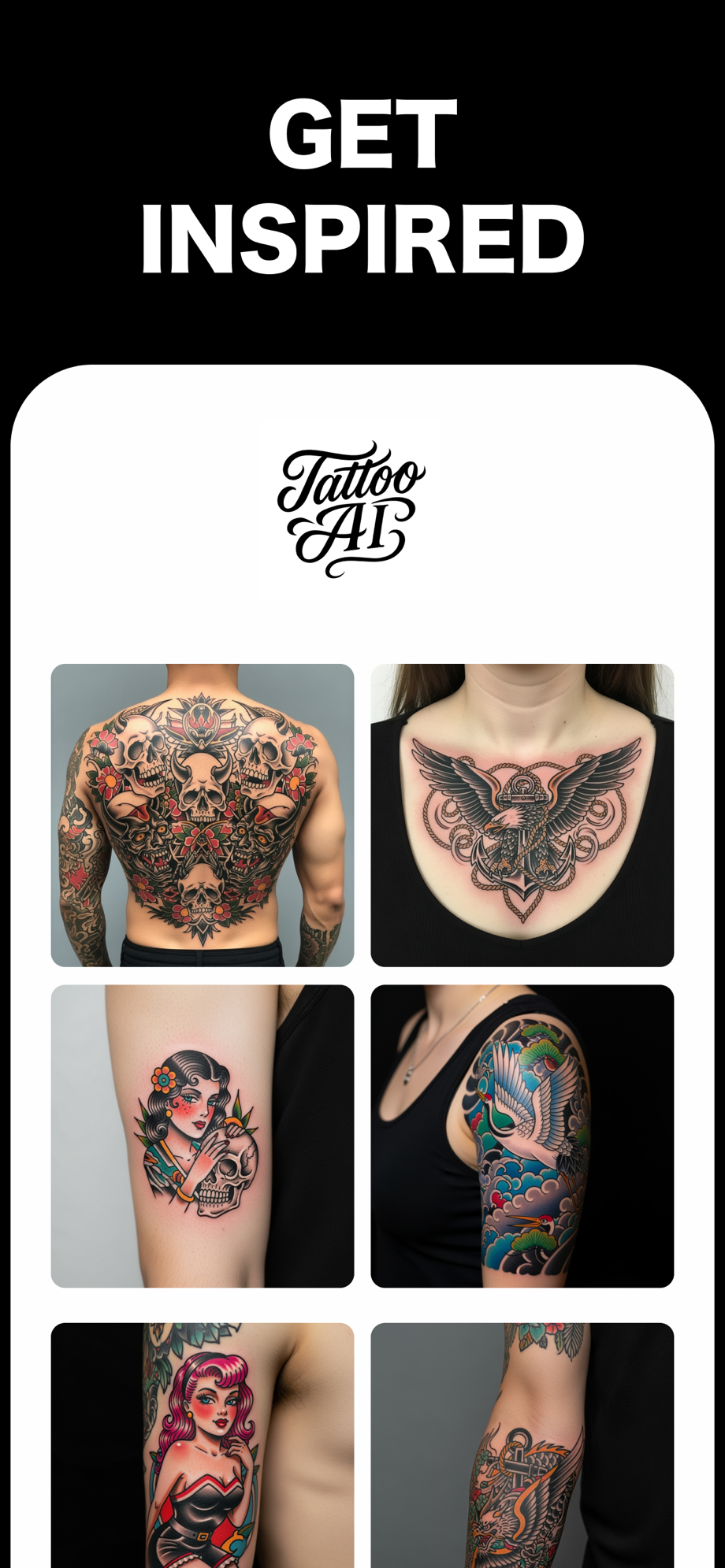
The most expensive sleeve mistake is discovering after 10 hours that you don't love the theme. Test it for free first with Tattoo AI:
- Generate your anchor piece — describe the centerpiece and pick the style you're committing to. Japanese, Traditional, and Realism all render with proper sleeve weight.
- Upload a photo of your arm — shoulder to wrist, relaxed at your side.
- Place it at half-sleeve scale — resize and rotate until the anchor sits where session one would put it.
- Confirm the theme. Generate two or three variations and compare on your own arm. Walk into the consult with the direction already proven, not a Pinterest board of other people's arms.
Free on the App Store · iPhone & iPad